Our lab sits in the Biodiversity Research Centre within the Department of Zoology. We are located on the Vancouver campus of the University of British Columbia. The campus is a short distance from downtown Vancouver, located within a temperate rainforest and surrounded by the breathtaking beaches and scenery of the Point Grey peninsula.
Graduate student opportunities
We are currently recruiting for two graduate students to join the lab.
Project details:
One project will primarily be experimental, with a focus on experimental evolution of cheating and cooperation in bacteriophages. Our lab primarily works with M13, a filamentous bacteriophage that infects E. coli bacteria. This project will involve basic microbiology techniques, with the opportunity to incorporate additional techniques depending on your interests. Possible methodological directions could include genetic engineering of viral cheats and cooperators, phenotypic characterisation of viral cheats, or high-throughput laboratory automation methods. Specific questions could include the role of coevolution in cheat/cooperator outcomes, the impact of social interactions on evolvability and adaptation within viral populations, or the repeatability of social evolution outcomes.
The second project will primarily be computational, with a focus on viral social dynamics in natural plant virus infections. Depending on your interests, this project could lean more towards bioinformatic analysis of sequencing data, or more towards mathematical modelling of social interactions. Projects could also involve a fieldwork component including sampling plants for viral infections. Specific questions could include the role of defective viral genomes in natural plant infections, the dynamics of satellite and helper plant viruses, or the epidemiological consequences of viral social interactions.
In both cases, we will decide on your specific research questions through conversations and in alignment with your goals and interests. All students in our lab get the opportunity to experiment with different methodologies and to collaborate on projects that involve a mixture of modelling, sequence analysis, and experimentation.
Timelines:
We will begin to assess applications for both positions on May 1st 2026. It is possible to start as early as September 2026, but you could also start in January 2027 or later if that works better for you.
Financial details:
Both graduate positions are fully funded. The salary will be $35,000 CAD in the first year with annual increases in line with inflation. Tuition is covered and TAing is not required in the first year, although we may suggest that you TA a specific course depending on your existing background. There are many opportunities to apply for fellowships, some of which provide additional salary.
Degree details:
We are open to recruiting either MSc or PhD students. If you already have a Master’s degree, we will enter you on the UBC Zoology PhD programme. If you do not have a Master’s degree, we will enter you on the UBC Zoology MSc programme, with the opportunity to transfer to the PhD programme after one year. Both programmes come with some course requirements in the first year, and we will help to guide you in selecting the most useful courses for your project. In both cases, the salary is the same, and your primary objective during your degree will be research. There is no set length for a PhD degree at UBC Zoology, but in our lab we aim to graduate PhD students within 4-5 years of their start date. We can take both domestic and international students.
What we’re looking for:
(1) We are looking for genuine enthusiasm for the academic research directions in our lab. It is critical that you find social evolution in viruses genuinely exciting, and that the ideas themselves interest you.
(2) It is important that you are intellectually collaborative, generous with your time and ideas, and that you enjoy regular academic conversations with peers. We expect new lab members to engage with the academic community within our lab and broader environment, which includes ongoing collaborations with other labs in our building, regular academic visitors, and multiple weekly discussion groups and journal clubs.
(3) It is a bonus if you can demonstrate evidence of your resilience, or the ability to see projects through to completion, even if your past experiences are in a non-academic context. Graduate school is a marathon rather than a sprint, and everybody faces challenges that they must overcome during graduate school.
To Apply
To apply for one of the graduate student positions above, please email asher.leeks@ubc.ca with the following:
- Your CV
- One paragraph describing an open research direction or question within sociovirology. Please give details on why you are interested in the specific open question you’ve chosen. Feel free to draw from one or more of our recent review papers for this (e.g. our cheating review, our open questions review, or our clinical opportunities perspective).
- One paragraph describing how some of your past experiences or interests relate to our lab’s academic directions.
Please do not use generative AI in your email.
We will begin to look at applications on 1st May 2026, and will continue to look at applications on a rolling basis after that.
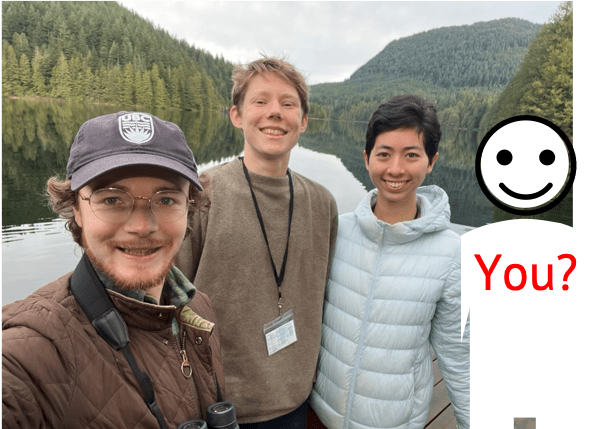
NB: We are always happy to hear from prospective graduate students and postdocs. If there is no specific opportunity listed on this page, please feel free to reach out to Asher with your general interests and we can discuss future opportunities.
 Asher Leeks